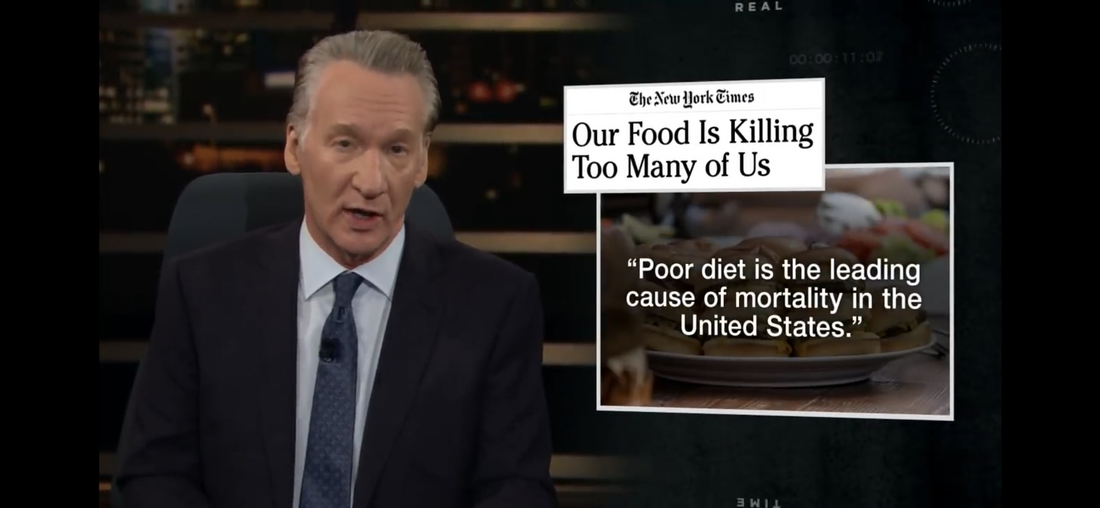
When introducing a panel discussion titled: Why we get fat, Keith Humphreys (Professor of Psychiatry and Behavioral Sciences - Stanford School of Medicine) stated: Is there any way to stay thin other than living on a diet of yogurt and wicker furniture?

This statement perpetuates the myth that food with health benefits taste horrible. Sorry, Dr. Humphreys, there are many delicious foods that provide health benefits. 

While I have eaten plenty of yogurt (Choboni for me), I can assure you, wicker furniture has never crossed my lips.


So, I was excited to read this article by Michael Pollan - Some of My Best Friends are Germs.

It's a long article and my area of interest is this part of the article:

Alas, I am impatient. So I gave up asking scientists for recommendations and began asking them instead how, in light of what they’ve learned about the microbiome, they have changed their own diets and lifestyles. Most of them have made changes. They were slower to take, or give their children, antibiotics. (I should emphasize that in no way is this an argument for the rejection of antibiotics when they are medically called for.) Some spoke of relaxing the sanitary regime in their homes, encouraging their children to play outside in the dirt and with animals — deliberately increasing their exposure to the great patina. Many researchers told me they had eliminated or cut back on processed foods, either because of its lack of fiber or out of concern about additives. In general they seemed to place less faith in probiotics (which few of them used) than in prebiotics — foods likely to encourage the growth of “good bacteria” already present. Several, including Justin Sonnenburg, said they had added fermented foods to their diet: yogurt, kimchi, sauerkraut. These foods can contain large numbers of probiotic bacteria, like L. plantarum and bifidobacteria, and while most probiotic bacteria don’t appear to take up permanent residence in the gut, there is evidence that they might leave their mark on the community, sometimes by changing the gene expression of the permanent residents — in effect turning on or off metabolic pathways within the cell — and sometimes by stimulating or calming the immune response.
 
 
I love "the study of the day". 

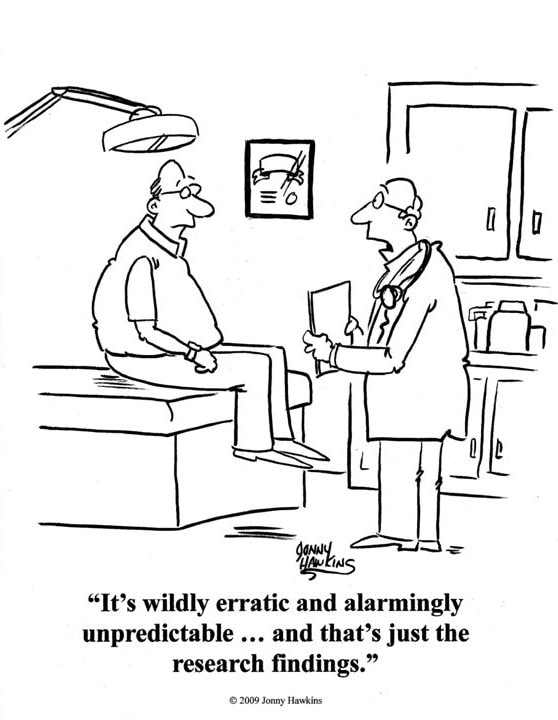
Today, a report came out that salt ain't so bad for us after all. The amazing and incredible cartoonist, Jonny Hawkins, came up with this one. It's in my book too. Because, I discovered much of the "scientific" research ain't so scientific. 

Don't believe me? Check out this article: Lies, Damn Lies, and Medical Science. If you find the article intriguing, there are many wonderful books to read about the lack of science in scientific research. You might be shocked. I was.
 
 
Picture
*Rip Esselstyn just released the book: My Beef with Meat. While I have nothing against a Vegan lifestyle (hey, my football hero Tony Gonzales is a Vegan) or Paleo, for that matter, I do have a beef when people imply it's "my way or the highway". Unfortunately, that's what many people do. 

In a CBS interview, Rip stated that his beef with meat is: It clogs arteries. It fuels cancer. Contributes to obesity. It trashes the environment. Chicken has the same cholesterol as red meat. Fish has more cholesterol than meat or chicken. One egg yolk has the same cholesterol as two Burger King whoppers. One glass of whole milk has the same saturated fat as four slices of bacon and two times the calories.

While there may be valid scientific or ethical reasons to live a Vegan lifestyle, some of the above information is misleading. For example, many things fuel cancer and obesity, such as, sugar. As far as comparing an egg to a Burger King Whopper, that's a whopper of a tale. Current scientific information proclaims that the cholesterol in an egg does not equate to creating cholesterol in your body. Furthermore, an egg is an excellent source of protein, it aids with satiety, and can be a great snack (one hard-boiled egg is only 70-calories).

*Rip's dad, Dr. Caldwell Esselstyn, wrote the book Prevent and Reverse Heart Disease. One of my favorite quotes, I attribute to him: Genes load the gun, but lifestyle pulls the trigger. Yes, upwards of 75% of our health outcomes can be attributed to our lifestyle.


Because of all these diet camps, I came up with this cartoon (Jonny Hawkins created it for me) and this diagram. For healthy eating, follow the middle part of the diagram. And where you see the word no, it can be replaced with occasionally or rarely.

A much better message would be: lay off the fast-food, junk food, soda, processed food, and minimize the sugar. After all, about 70% of our "food" consumption is processed and we eat a tremendous amount of fast-food.


I'm the world's biggest cynic. So, I love B.S. like this. Here's the headline: Coca-Cola pledges $3.8 million in grants to fight obesity in Georgia and the article

If this picture wasn't so funny, it would be sad. The CEO of Coca-Cola just slipped $3.8-million into the pocket's of Governor Deal and Mayor Reed. Hey, I'd be smiling too.

The only problem is this: Coke's premier product is one (certainly not the only) of the causes of obesity. And get this: If you drink one 12-ounce Coke per day, you will be consuming 32-pounds of sugar per year. It would fill a 5-gallon water jug. Take a look.

I live in the great city of Atlanta - Coca-Cola's home town. So, here's my advice. If you are ever in Atlanta, visit the Coke Museum, but do not drink its products. Okay, you can drink Dasani. But I'm not sure why you would do that. Water is free and Dasani is expensive.